Ideal Standing Desk Height: Finding Your Fit
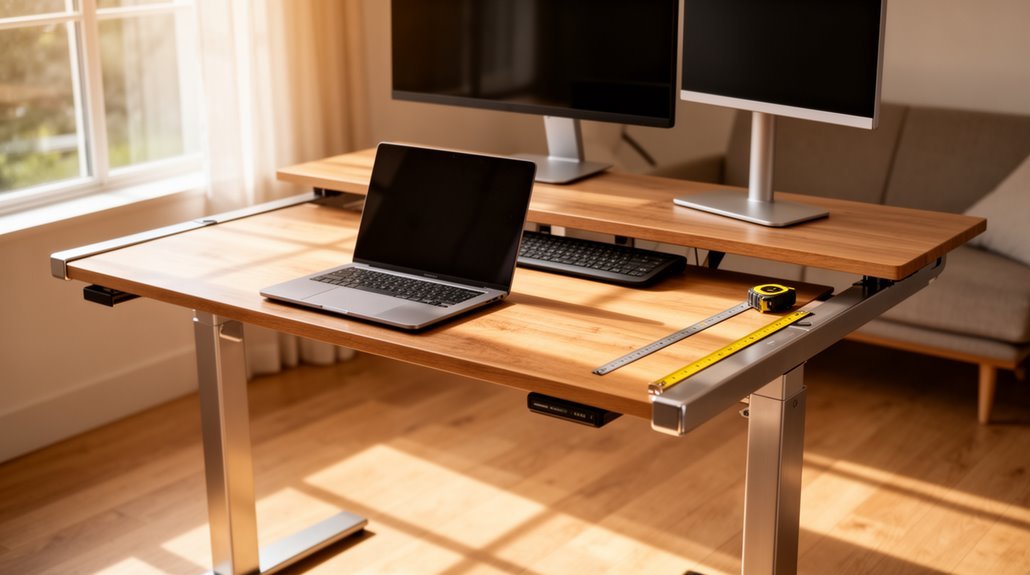
Ideal standing desk height is found by measuring your elbow height while standing straight.
Your desk height should fall between 0.4739 × your height − 6.678 inches and 0.5538 × your height − 9.4270 inches. When standing, your elbows should bend at about 90 degrees and your wrists should remain straight.
Make sure your feet rest flat on the floor for stable support. Adjustability is key so you can customize the setup to your body proportions.
Let’s explore other essential aspects of desk ergonomics.
Understanding Ergonomics and Desk Height
An ideal desk height is essential for maintaining ergonomic integrity during work. Your elbows should bend at a 90-degree angle when resting on the desk surface, ensuring comfort. Keep your forearms parallel to the floor, avoiding strain or hunching. Let your shoulders hang naturally, preventing tension. Your wrists must remain straight and aligned with the keyboard, promoting neutral positioning. Additionally, maintain an upright spine to prevent slouching. When desk height is incorrect, you may experience elevated shoulders or a rounded back, both of which contribute to discomfort. Proper alignment reduces pressure on your wrists and strains in your arms. Proper desk height supports your overall well-being and enhances your productivity. Prioritizing ergonomic setup enhances your long-term musculoskeletal health and overall productivity.
Height Recommendations Based on User Height
When determining your ideal standing desk height, it’s crucial to take into account your specific height to guarantee proper ergonomics.
Users between 5’0″ and 5’5″ should aim for desk heights of 36″ to 41″.
For those 5’6″ to 5’9″, recommended heights are typically 40″ to 44″.
Taller individuals, from 6’0″ to 6’3″, should set their desks between 43″ and 47″.
Finally, users above 6’3″ may need desk heights of 48″ to 50″.
Always measure your elbow height with shoes on for accuracy.
This guarantees your elbows remain bent at 90 degrees and your forearms stay parallel to the desk, reducing the risk of strain and promoting a neutral wrist position. Correct height is essential for good posture, reducing fatigue, and enhancing work results.
Calculating Your Ideal Desk Height
Calculating your ideal desk height requires precise measurements and careful consideration of your body proportions.
Start by measuring your height while wearing your usual footwear. Stand against a wall, mark the height with a hardcover book, and measure from the ground to the mark.
Use the formula 0.4739 × height (in inches) − 6.678 for the minimum desk height, and 0.5538 × height (in inches) − 9.4270 for the maximum. The average height for a standing desk is typically between 38 and 46 inches, which can help guide your calculations.
Measure your elbow height with arms relaxed, then add 1-2 inches for suitable desk surface height. Adjust the desk until your elbows form a 90-degree angle.
Test the height for comfort, monitoring for strain or discomfort. Periodically reassess as your needs may change.
The Importance of Adjustable Desks
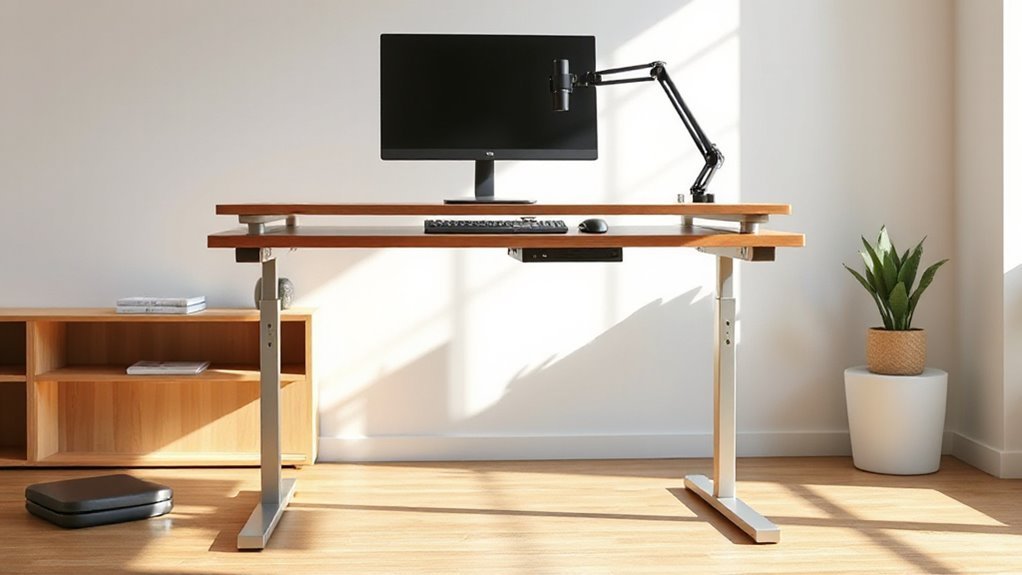
Adjustable desks play an essential role in promoting ergonomic work environments, as they allow users to modify their workstation to fit their individual needs.
Height-adjustable desks markedly reduce upper back, neck, and shoulder pain; studies show 32-54% pain reduction within weeks. Users report increased productivity, with 65% experiencing improvements after one year.
Standing for just one hour enhances energy levels and cognitive function, as 87% feel more energized. Additionally, adjustable desks help decrease sedentary behavior by 17%, allowing for sustained focus and engagement.
Adoption rates exceed 90% with proper introduction, offering substantial returns on investment through reduced healthcare costs and improved employee well-being.
Ergonomic Features and Accessories
Ergonomic features and accessories greatly enhance the user experience with standing desks.
Desks should have a height adjustability range from 23″ to 49″, accommodating most adult users in both seated and standing positions. A minimum weight capacity of 180 lbs is typical, with some desks supporting over 500 lbs for heavy equipment.
Stability is essential, especially at maximum height, with 4-leg frames providing enhanced support. Electric motors enable smooth height adjustments, with speeds ranging from 1″/sec to 1.6″/sec.
Built-in cable management solutions, such as trays and grommets, keep cords organized. Additionally, monitor arms and ergonomic accessories like keyboard trays and anti-fatigue mats promote correct posture, reducing strain and enhancing comfort during use.
Common Mistakes in Desk Height Setup
Have you ever wondered why your workspace feels uncomfortable? Many common mistakes in desk height setup lead to discomfort and strain.
Here are four key errors to avoid:
- Incorrect Desk Height: Desks set too high or low can prevent your elbows from maintaining a 90-degree angle, causing shoulder and neck strain.
- Neglecting Adjustment Range: Adjustable desks often don’t lower enough for shorter users, limiting comfort for diverse users.
- Improper Monitor Positioning: Monitors too high or low lead to neck strain and eye fatigue, disrupting your focus.
- Relying Solely on Height Charts: Generic charts ignore individual body dimensions, resulting in poor fit and posture.
Addressing these issues can greatly enhance your workspace comfort and overall productivity.
Fine-Tuning Your Setup for Comfort
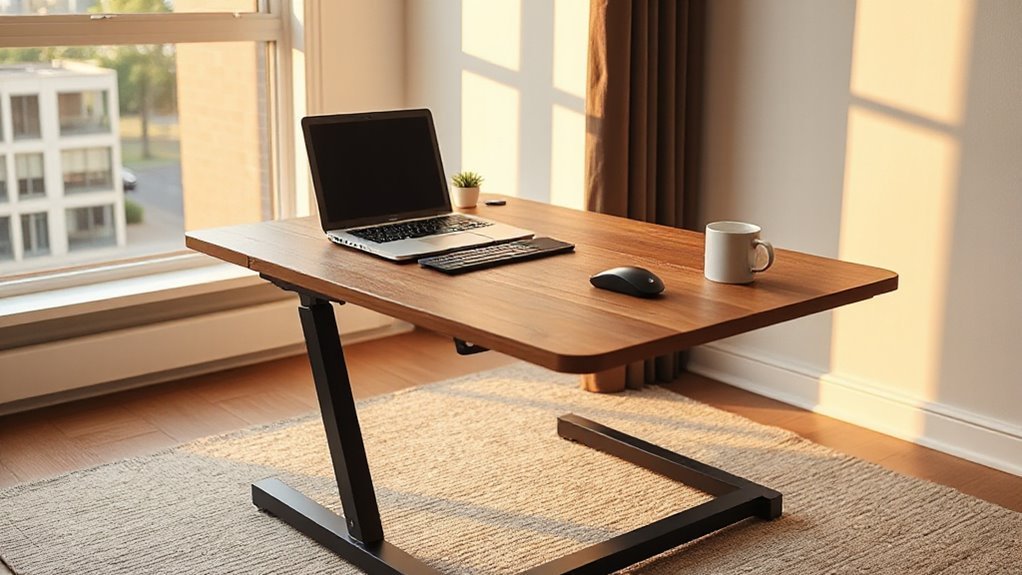
To enhance your workspace comfort, it’s crucial to maximize various aspects of your standing desk setup.
Start with footwear; supportive shoes reduce fatigue, while cushioned insoles or anti-fatigue mats absorb impact and promote circulation. Avoid hard flooring, as it increases discomfort.
Next, focus on posture. Maintain a neutral spine, keep your knees slightly bent, and distribute your weight evenly across both feet.
Incorporate movement strategies; alternate between standing and sitting every 30–60 minutes. Use the 20-8-2 rule to guarantee consistent movement.
Finally, consider accessories. Anti-fatigue mats improve comfort, while adjustable components allow customization to your specific needs.
Regularly reassess your setup to maintain peak comfort throughout your workday.
The Role of Monitor Positioning
Proper monitor positioning plays a significant role in creating a comfortable and productive workspace. To optimize your setup, consider the following:
- Eye Level Alignment: Position the top of your monitor screen at or slightly below eye level, ensuring your eyes align with a point 2-3 inches below the screen’s top.
- Viewing Distance: Keep your monitor at an arm’s length (20-30 inches) to minimize eye strain. Adjust based on screen size: 21-inch screens at 20-28 inches, 24-inch at 24-32 inches, etc.
- Screen Angle: Tilt your monitor 10-20 degrees upward to reduce glare and neck strain.
- Direct Front Positioning: Align the monitor’s center with your nose to prevent neck twisting and maintain a neutral posture.
Maintaining Good Posture While Working
Good posture is essential for preventing discomfort and enhancing productivity during work.
Maintain a straight spine, with your head directly above your pelvis to avoid forward head posture. Your shoulders should align with your hips, relaxed and not hunched. Keep your neck neutral, facing forward, while your hips support a natural ‘S’ curve in your spine.
Avoid locking your knees; keep a slight bend. Set your desk height to elbow level, ideally around 44 inches for someone 5’11”. Verify your wrists are straight and aligned with your forearms, avoiding any bending.
Keep your feet flat on the floor or use a footrest. Remember to alternate between sitting and standing every 30 to 60 minutes to promote movement and circulation.
Frequently Asked Questions
How Often Should I Switch Between Sitting and Standing?
You should switch between sitting and standing every 30 minutes for ideal benefits.
This interval helps reduce discomfort and boosts energy levels. If 30 minutes feels too long or short, adjust to 20 or 45 minutes based on your comfort.
Remember, blood flow decreases after 20 minutes in any static position.
Regularly changing your posture can greatly enhance circulation and reduce back pain, contributing to better overall productivity throughout your workday.
Can I Use a Treadmill While Working at a Standing Desk?
Yes, you can use a treadmill while working at a standing desk, but safety precautions are crucial.
Make certain your treadmill features a safety key and sturdy handrails. Wear proper footwear to prevent slips. Keep cords clear of moving parts to avoid entanglement.
Monitor your speed, as excessive pace may hinder focus. Also, consider your workspace; a wider desk provides stability and reduces the risk of accidents while multitasking.
What Type of Shoes Are Best for Standing Desks?
You should choose shoes with proper arch support to prevent foot fatigue.
Look for options like Dansko clogs or OOFOS OOcloog shoes, which offer solid arch support and cushioning.
Ascertain your shoes have a spacious toe box to accommodate natural swelling and provide comfort.
Non-slip soles are essential for safety in professional settings.
Aim for lightweight designs that minimize fatigue during long periods of standing, utilizing cushioning to absorb shock effectively.
How Can I Remember My Preferred Desk Height Settings?
To remember your preferred desk height settings, document every measurement meticulously.
Record your elbow height, shoe type, and heel height in a dedicated notebook or digital format. Use visual markers on the desk for quick reference.
Set smartphone reminders for periodic checks. Create a baseline sheet that includes both sitting and standing heights.
Regularly review these records, ensuring your workspace remains ergonomically optimized and comfortable, adapting as necessary for any seasonal changes.
Are There Specific Exercises to Relieve Standing Desk Fatigue?
Yes, specific exercises can relieve standing desk fatigue.
Calf raises strengthen lower legs, improving circulation. Two-stage calf raises target both calf muscles.
Standing quad stretches relieve thigh tightness. For the upper body, back extensions counteract poor posture.
Standing spine twists enhance spinal mobility. Shoulder rolls alleviate tension, while wrist pulls reduce forearm fatigue.
Incorporate these exercises regularly to promote comfort and reduce fatigue throughout your workday.
Conclusion
Finding your ideal standing desk height is essential for maintaining comfort and productivity.
Consider your height, desk features, and monitor positioning to create an ergonomic workspace.
An adjustable desk can adapt to your needs, while proper posture helps prevent strain.
Are you maximizing your setup for peak performance? By paying attention to these factors, you can enhance your work experience and promote long-term health.
Prioritize your comfort for a better workday.