Monitor Arm Alternatives for Your Workspace
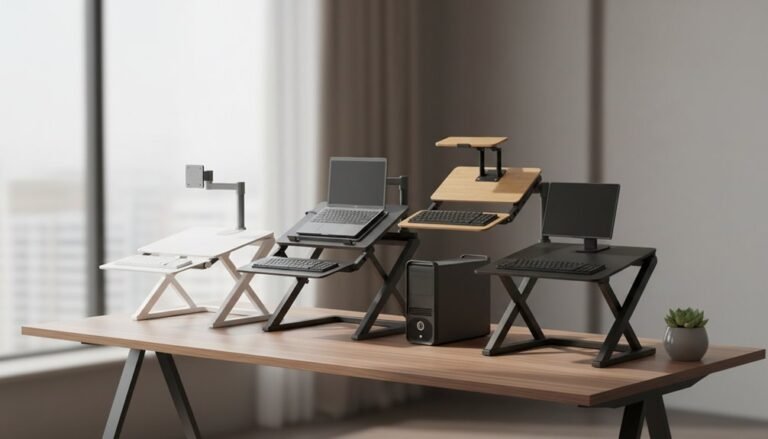
If you’re looking for monitor arm alternatives, consider various types of monitor stands. Basic and adjustable stands provide stable platforms with height options to suit different viewing preferences and ergonomic needs.
Stackable stands maximize vertical space and reduce your desk footprint, which is useful in compact work areas. Monitor risers with storage offer ergonomic heights plus compartments to keep cables, notebooks, and accessories organized.
Multi-monitor stands accommodate multiple displays for streamlined workflows and efficient workspace usage. These options all enhance ergonomics while helping keep your workspace organized. Continue exploring to uncover detailed specifications and practical recommendations tailored to your needs.
Basic Monitor Stand
When you consider monitor stands, basic models offer a range of options tailored to various needs.
Fixed stands provide a stable platform at a set height, perfect for standard setups.
Riser stands allow height adjustments without removing the monitor, enhancing usability.
Stackable adjustable stands require lifting the monitor for height changes, offering flexibility.
Pole-type stands are simple and stable but lack easy adjustments.
You’ll find single monitor stands designed to elevate one screen, focusing on ergonomic height and limited tilt functionality. Most use high-quality metals like aluminum or steel for durability, which is essential for high-quality materials. Their compact footprints minimize desk space usage, while wide bases guarantee stability. Always verify weight capacity to match your monitor for safe use.
Adjustable Monitor Stand
Adjustable monitor stands offer numerous features designed to enhance your workspace’s ergonomics and functionality.
These stands typically provide multiple height settings, from 12.6 inches to 19.7 inches, promoting comfortable viewing levels. You can tilt monitors between -20° and +60°, swivel them 40° to 60°, and achieve full 180° to 360° rotation for ideal positioning. Additionally, many adjustable monitor stands are compatible with 17” to 27” monitors, ensuring a wide range of display options for users.
- Supports monitors from 17 to 32 inches, including VESA-compatible mounts.
- Constructed from durable steel to hold up to 15 pounds securely.
- Built-in cable management reduces clutter and organizes cables effectively.
- Easy adjustments allow seamless shifts between sitting and standing.
Using an adjustable monitor stand can greatly improve your posture and reduce discomfort during extended work hours.
Stackable Monitor Stand
Stackable monitor stands provide an efficient solution for maximizing your workspace while improving ergonomics.
These stands utilize vertical space, reducing your desk footprint by up to 50% compared to side-by-side setups. You can stack dual monitors, freeing up significant desk area for other essentials. Their compact designs fit well in tight workspaces, making them great for small desks. Dual monitors can increase productivity by 42%, allowing you to work more efficiently.
Adjustable height options help align screens with your natural eye level, reducing neck and eye strain. Most stands support monitors from 13 to 34 inches and can hold up to 44 pounds each.
Integrated cable management systems keep cords organized, minimizing visual clutter, while VESA mounts guarantee compatibility with various monitor brands.
Monitor Riser With Storage
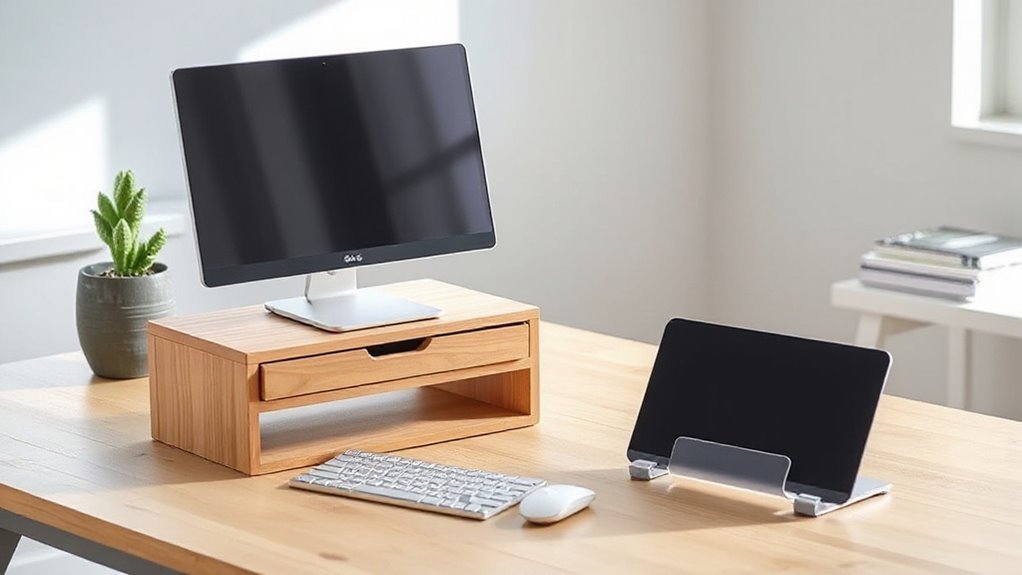
Monitor risers with storage combine functionality and organization, making them an excellent choice for optimizing your workspace.
These risers typically feature durable materials like engineered wood or aluminum. They offer 2-3 layers, each providing about 2.2 inches of clearance. Ergonomic heights range from 4.3 to 6 inches, with some models including adjustable legs.
- Support weights from 20 to 88 pounds, accommodating various monitor sizes.
- Include built-in storage compartments for organizing office supplies.
- Optimize under-monitor space for keyboards or documents.
- Integrate cable management systems to minimize clutter.
Multi-Monitor Stand
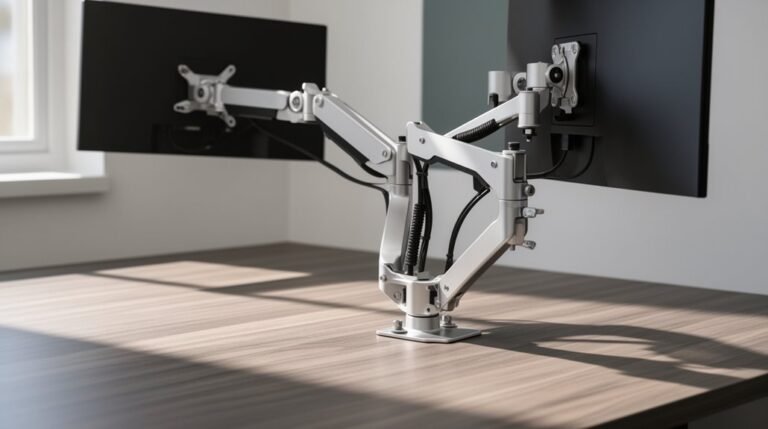
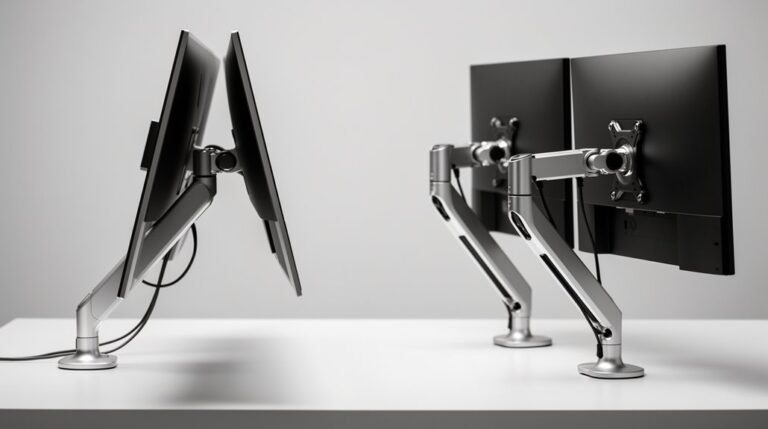
A multi-monitor stand greatly enhances productivity by allowing you to arrange multiple displays for ideal viewing.
These stands accommodate various configurations, from dual to octuple setups, often featuring vertical stacking or multi-tier arrangements. You can find heavy-duty options for triple monitors or modular systems that expand to eight monitors.
Adjustable features allow you to tilt, pivot, and swivel displays, optimizing ergonomic angles. Integrated cable management systems keep wires organized, reducing clutter.
It’s essential to check compatibility with VESA mounting standards and monitor sizes, as most stands support monitors up to 27 inches. Additionally, weight capacity per arm typically ranges from 7 to 22 lbs, ensuring stability across your chosen configuration.
Space-Saving Benefits of Monitor Stands
When optimizing your workspace, the space-saving capabilities of monitor stands can greatly enhance your productivity.
These stands elevate your monitors, freeing up valuable desk space for other essentials. You can enjoy benefits such as:
- Increased Surface Area: Monitor stands create room for keyboards, notebooks, and accessories.
- Underneath Storage: Utilize the space below for documents or input devices, keeping your desk organized.
- Built-in Compartments: Some stands feature storage options that maintain a decluttered workspace without expanding your desk’s footprint.
- Cable Management: Many stands include cable management systems to reduce clutter and enhance aesthetics.
Ergonomic Considerations for Monitor Setup
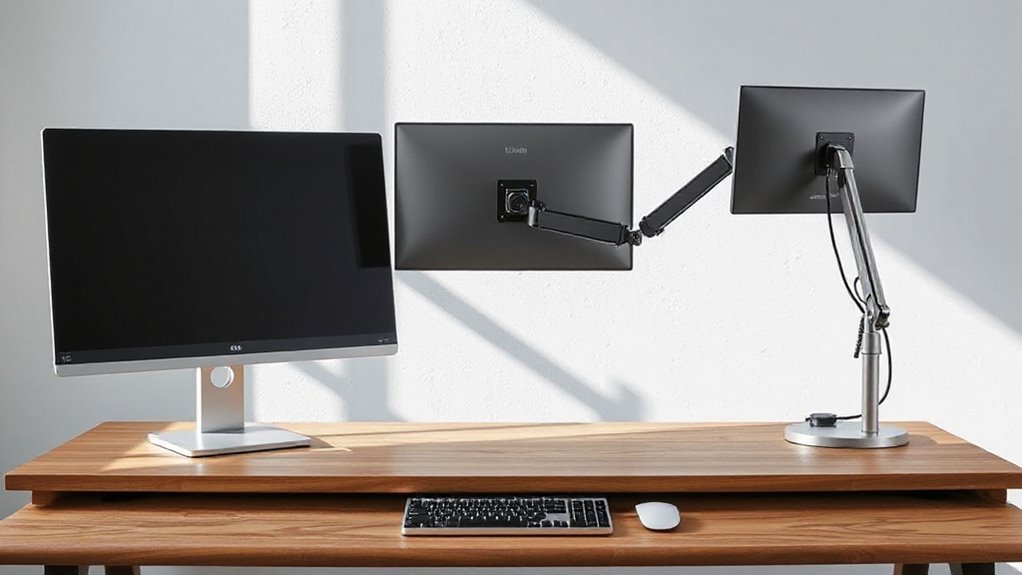
To guarantee a comfortable and productive workspace, it’s essential to focus on the ergonomic setup of your monitor.
Position the top of the screen at or slightly below eye level, aligning your eyes with a point 2–3 inches below the monitor’s top. For bifocal users, lower the monitor by 2–5 cm.
Maintain a viewing distance of 50–65 cm (20–26 inches) for ideal comfort. Tilt the screen back 10°–20° to reduce glare and align with your line of sight.
Make certain the monitor is directly in front of you, centered with your nose, and avoid placing it to the side.
Control glare with proper lighting, positioning the monitor away from windows, and using anti-glare protectors when necessary.
Frequently Asked Questions
Can Monitor Stands Support Heavy Monitors Effectively?
Yes, monitor stands can support heavy monitors effectively.
Steel stands offer the highest weight capacity, typically supporting up to 44 lbs (20 kg) per arm. Aluminum stands balance strength and lightness but generally support less weight.
Make certain the arm’s design, including support joints and extension length, accommodates your monitor’s weight. Regularly inspect joints and clamps to maintain safety, and confirm VESA compatibility for secure mounting.
Proper installation is essential for stability and support.
Are Monitor Stands Portable for Travel or Remote Work?
Yes, monitor stands are portable for travel or remote work. They typically weigh under 250 grams, making them ultralight and easy to carry.
Their compact design fits efficiently in luggage without consuming much space. Many models feature foldable mechanisms and magnetic connection systems for quick setup.
Adjustability allows you to elevate monitors to eye level, enhancing ergonomics wherever you are. This flexibility supports both single and dual-screen configurations, ideal for various work environments.
Do Monitor Stands Come in Different Colors or Designs?
Yes, monitor stands come in various colors and designs.
Black and white are the most popular, while gray serves as a neutral choice. You’ll find blue in select models, and premium brands offer natural wood tones like walnut and maple.
Design variations include minimalist, modern, and industrial styles, each with unique materials.
Articulating arms allow for adjustable positioning, while modular designs enable customization, enhancing both functionality and aesthetics in your workspace.
Can I Use a Monitor Stand With Laptop Setups?
Yes, you can use a monitor stand with laptop setups. Verify the stand supports your laptop’s weight, typically between 2.2 to 33 lbs.
Check for VESA compatibility, as many laptops need an adapter or tray. Adjustable stands enhance ergonomics by elevating the screen to eye level, reducing strain.
Look for robust models to prevent wobbling during typing. Some stands also improve airflow, helping to avoid overheating during extended use.
How Do I Clean and Maintain My Monitor Stand?
To clean your monitor stand, first power down and unplug it.
Use a microfiber cloth dampened with distilled water for general dusting. For stubborn grime, apply a monitor-safe cleaner or a vinegar solution.
Wipe from top to bottom, focusing on joints and hidden areas.
Establish a routine every two weeks to maintain performance, ensuring air vents are clear.
Regularly check moving parts for smooth operation after cleaning.
Conclusion
In conclusion, choosing the right monitor stand can transform your workspace.
A basic monitor stand raises your screen, while adjustable options cater to varied heights.
Stackable stands offer versatility, and those with storage maximize utility.
Multi-monitor stands enhance productivity and support diverse work needs.
When considering ergonomic factors, verify your monitor is at eye level to reduce strain.
Just as a solid foundation supports a sturdy building, the right stand supports an efficient and comfortable workspace.