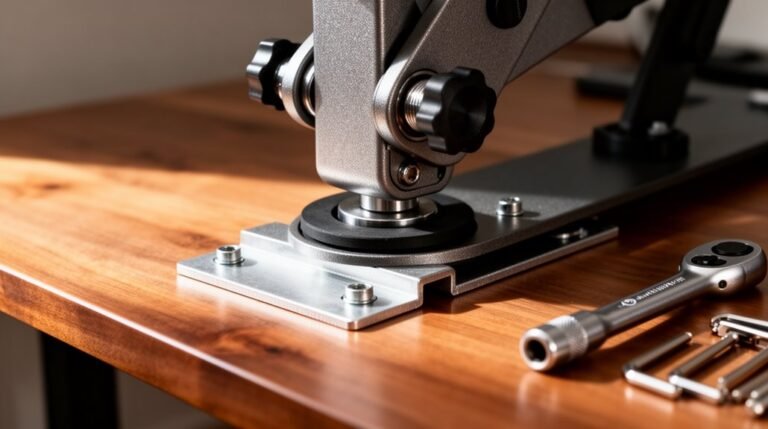
Standing Desk Converter Setup Tips
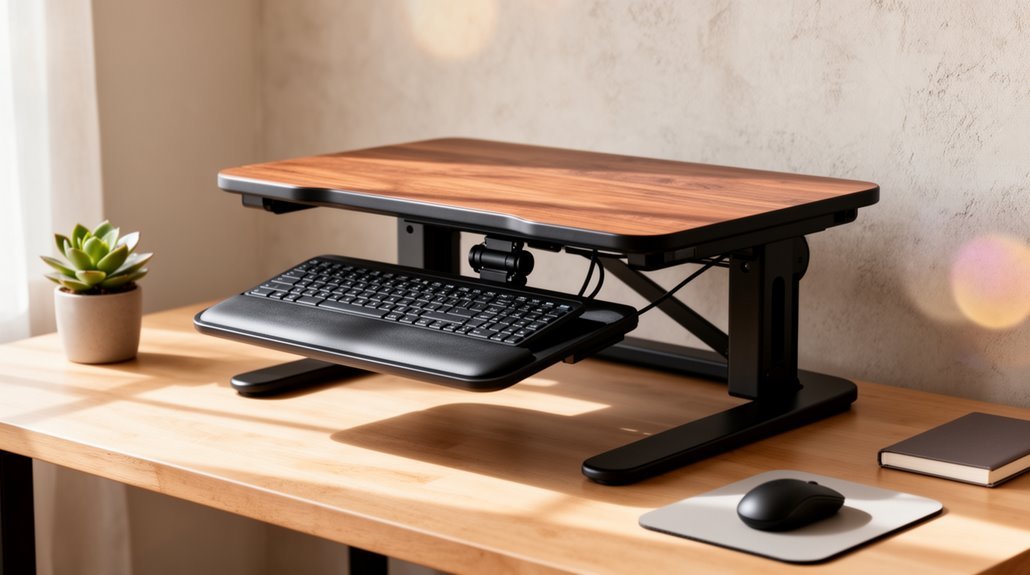
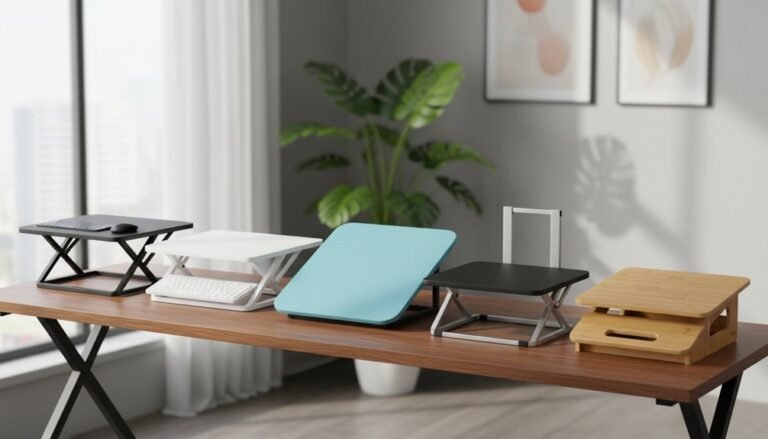
Standing Desk Converter Setup Tips: Choose the right converter type for your needs. X-lift models provide excellent stability, Z-lift units offer a larger workspace, and L-lift designs focus on aesthetics.
Confirm your desk meets minimum dimensions of 36 inches wide by 29 inches deep before installing a standing desk converter. Using VESA-compatible mounts for monitors helps keep screens secure and aligned.
Place monitors at eye level and follow assembly guidelines carefully. Clear your workspace, manage cables efficiently, and test height adjustments to ensure smooth operation.
For additional proficiency in setup techniques, consider reviewing more detailed insights and manufacturer instructions.
Choosing the Right Standing Desk Converter
When selecting a standing desk converter, it’s essential to contemplate various factors that align with your workspace needs.
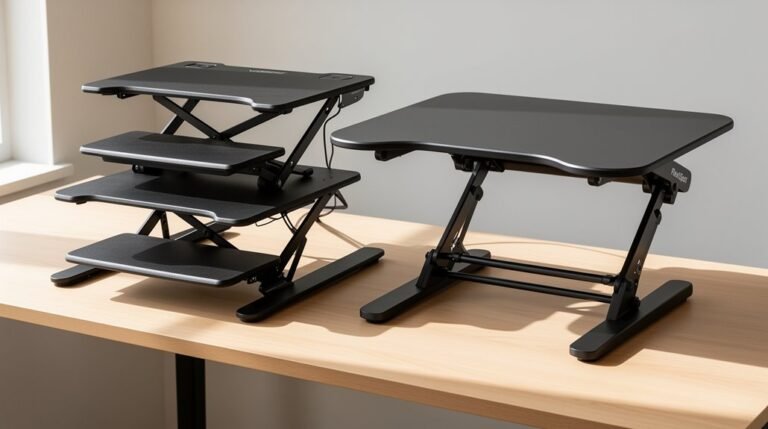
First, consider the type of converter. X-lift converters offer stability and can support dual monitors, while Z-lift converters provide a larger workspace but may be bulkier and costlier. L-lift converters enhance aesthetics and accommodate multiple monitors, but they can lack stability.
Next, evaluate the adjustment mechanism. Manual spring-assisted models require no assembly, while gas spring models allow smooth, one-handed adjustments. Electric motorized converters are excellent for quick height changes and help encourage health and flexibility in your work environment.
Finally, assess the work surface size and weight capacity. Aim for a model that fits your equipment comfortably, ideally supporting at least 33 lbs for dual setups.
Easy Assembly and Setup Guidelines
Setting up your standing desk converter efficiently requires careful preparation and attention to detail. Incorporating the ergonomic benefits of standing desks can enhance your workspace significantly, promoting better posture and reducing strain. By strategically adjusting the height of your desk throughout the day, you can encourage more movement and increase your overall productivity. Additionally, these desks often come with features that allow for seamless transitions between sitting and standing, ensuring that comfort is prioritized while you work. proper posture at your standing desk can significantly enhance your productivity and reduce discomfort. It’s essential to position your monitor at eye level and keep your feet flat on the ground for optimal alignment. Additionally, taking regular breaks to stretch can help maintain good posture throughout the day.
First, confirm your desk surface’s sturdiness and dimensions, guaranteeing a minimum width of 36 inches and depth of 29 inches. Clear your workspace to prevent damage and gather all hardware, including Allen wrenches and screwdrivers. Inspect all parts for damage or missing components according to the manufacturer’s checklist.
Next, position the base with felt pads at corners to protect the desk surface. Align the base’s front edge flush with the desk front for ergonomic reach. Securely fasten the lifting column, attach the worksurface bracket, and install the monitor and keyboard trays. Additionally, ensure that you are aware of the ergonomic benefits of height adjustment to promote a healthier workspace.
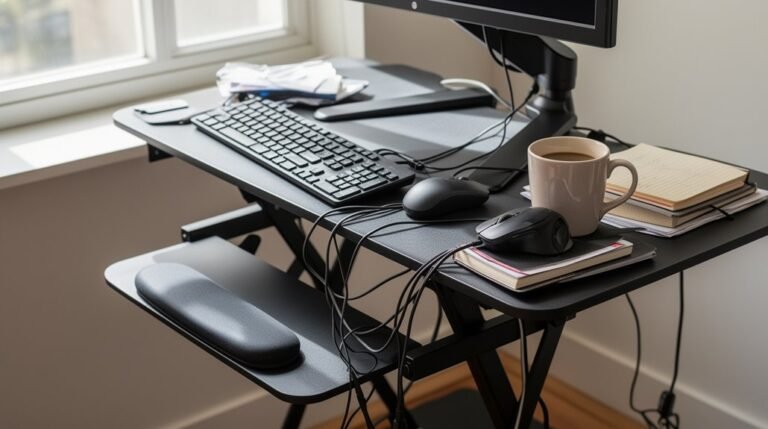
Finally, manage cables effectively to guarantee smooth functionality during height adjustments.
Optimizing Desk Space and Footprint
To optimize your workspace effectively, consider the strategic arrangement of your standing desk converter and its surroundings. Choose a compact or tabletop unit to preserve valuable desktop area, ensuring room for essential work materials. If you have limited space, opt for an L-shape converter to utilize corners efficiently. Use freestanding converters or clamp mounts for flexible positioning, reducing clutter. Integrate vertical storage accessories nearby to enhance organization. Position frequently used items on your main desktop while storing less-used tools underneath or on the converter’s sides. Additionally, consider adjustable monitor arms for better ergonomics without increasing your desk’s footprint. These strategies will help you maximize your workspace while maintaining a functional and efficient setup. Moreover, utilizing a standing desk converter can promote health improvements by reducing sitting time and enhancing posture.
Configuring Monitors and Equipment
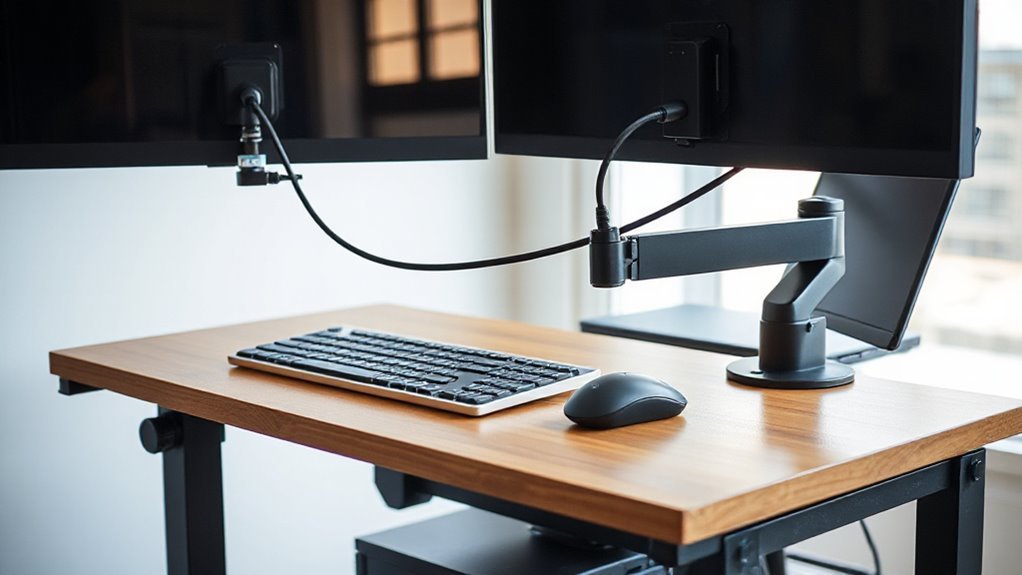
Configuring monitors and equipment effectively enhances your productivity and comfort.
Use VESA-compatible mounts for secure attachment; verify screws are the correct size to prevent damage. Position adjustment bolts on the mounting arms facing upward for easy access. Align hooks on VESA mounts downward to improve stability.
Consider monitors up to 28 inches and 20 pounds for ideal ergonomic benefits. If using multiple monitors, arrange them in a slight curve to facilitate natural eye movement. Implement cable management solutions to reduce clutter and verify cables don’t interfere with height adjustments.
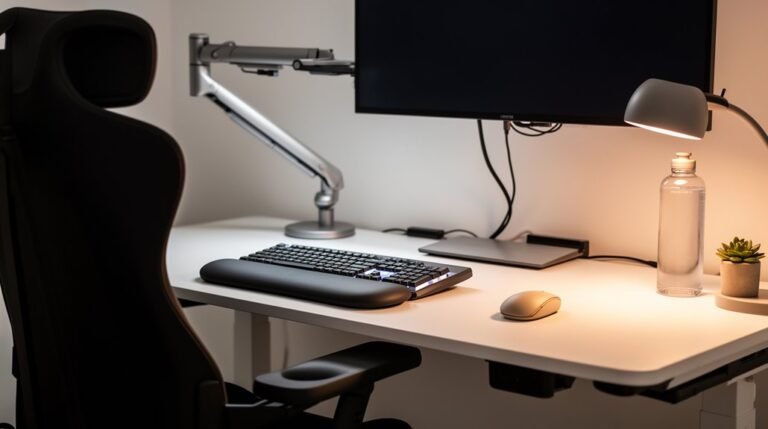
Place monitors at eye level, keeping the top of the screen slightly below your eye height. Maintain a neutral wrist position with your keyboard and mouse to minimize strain.
Understanding Height Adjustment Mechanisms
Understanding the height adjustment mechanisms in standing desk converters is essential for optimizing your workspace.
The X-Lift Mechanism offers stable vertical movement, ideal for budget models, but may have pinch points.
The Z-Lift Mechanism provides smoother adjustments with a curved track and gas strut design, allowing for ample workspace but requiring more desk space.
The Spring-Assisted Lift reduces effort for smooth adjustments, often paired with rowing lifts for ergonomic benefit.
The Gas Cylinder Lift provides infinite height adjustment with quick, smooth changes.
Finally, the Crank and Knob Manual Adjustment allows for simple, reliable height changes without electronics.
Each mechanism has its advantages and disadvantages, so consider your needs carefully when selecting a converter.
Ensuring Stability and Durability
Guaranteeing stability and durability in standing desk converters is essential for a reliable workspace. Here are key measures to maintain your converter:
- Regular Inspection: Check bolts, screws, and connections periodically to prevent wobbling and identify loose components early.
- Lubricate Moving Parts: Follow manufacturer guidelines for lubricating gas springs and adjustment mechanisms to guarantee smooth operation and minimal wear.
- Mind Load Capacity: Adhere to the specified maximum weight capacity to maintain structural integrity and avoid overloading, which can compromise stability.
- Structural Enhancements: Consider adding crossbars for increased rigidity, especially at full height, to reduce wobbling and improve overall durability.
Implementing these practices will enhance stability, prolong lifespan, and guarantee a safer workspace.
Frequently Asked Questions
How Do I Maintain My Standing Desk Converter?
To maintain your standing desk converter, regularly clean surfaces with a soft, damp cloth to prevent grime.
Use mild soap for tougher stains, avoiding harsh chemicals.
Periodically lubricate gas springs for smooth height adjustments, following manufacturer guidelines.
Inspect all bolts and screws for tightness to guarantee stability.
Respect the weight capacity of 39.6 lbs to avoid damage.
Organize cables with clips or trays to enhance safety and functionality in your workspace.
Can I Use a Standing Desk Converter With a Treadmill?
Yes, you can use a standing desk converter with a treadmill, but compatibility varies considerably.
Make sure the treadmill arms don’t exceed 9.4 inches in circumference to avoid attachment issues. Standard L-shaped desks may restrict space; consider models like iMovR that allow side-by-side placement.
Adjustable height settings on desk converters are essential for ergonomic alignment.
Check specifications for both the converter and treadmill to make certain a stable, functional setup tailored to your workspace requirements.
What Accessories Enhance the Standing Desk Experience?
Monitor and Mount Accessories
Adjustable monitor arms support multiple screens, freeing desk space. They offer 270° rotation and tilt functions for ideal viewing angles.
Ergonomic Input Devices
Ergonomic keyboards reduce wrist strain, while adjustable laptop stands promote better neck posture.
Comfort Accessories
Anti-fatigue mats cushion your feet, enhancing comfort during long periods of standing.
Cable Management
Integrated cable management systems keep your workspace organized, reducing clutter and hazards.
These accessories greatly enhance your standing desk experience.
Are There Specific Ergonomic Guidelines for Standing Desks?
Yes, there are specific ergonomic guidelines for standing desks.
Position your elbows at 90 degrees, keeping your shoulders relaxed. Adjust the desk height to elbow level, ideally between 65-125 cm.
Confirm your monitor is at eye level, about an arm’s length away, to prevent strain. Maintain a flat back and slightly bent knees for better circulation.
Use an anti-fatigue mat for comfort. Remember to alternate between sitting and standing regularly to reduce fatigue.
How Can I Prevent Fatigue While Using a Standing Desk?
To prevent fatigue using a standing desk, alternate your position every 30 to 60 minutes.
Gradually increase standing time, allowing your body to adapt.
Incorporate movement, such as mini-squats and calf raises, to activate muscles.
Utilize anti-fatigue mats for comfort and choose supportive footwear.
Maintain proper posture by aligning your head, shoulders, and hips.
Stay hydrated to sustain energy levels and enhance overall comfort during your work periods.
Conclusion
To sum up, setting up a standing desk converter involves careful consideration of various factors.
Make sure you select a model that suits your workspace and monitor needs.
For instance, a user named Sarah found that a dual-monitor setup increased her productivity greatly after she properly adjusted her converter to the correct height.
By following these tips, you can optimize your workspace, improve ergonomics, and maintain stability, ultimately enhancing your work experience.