Do Standing Desks Help You Lose Weight?
Do standing desks help you lose weight? Standing desks can increase calorie expenditure slightly, burning about 0.15 calories more per minute than sitting. For obese individuals, this difference can be somewhat larger, leading to higher energy burn.
However, simply using a standing desk isn’t likely to produce significant weight loss without adding other physical activities or dietary changes. While standing reduces sedentary time and can improve certain health markers, the direct weight-loss effects are minimal.
There is more to explore on how to maximize health benefits with standing desks, such as combining standing with light movement, regular breaks, and an overall active lifestyle.
Understanding Calorie Expenditure Differences
When you switch from sitting to standing, your body burns more calories, and this increase varies depending on several factors.
Research shows that standing desks can boost calorie expenditure by approximately 7.4 kcal every 30 minutes compared to sitting. This increase is more pronounced in obese individuals, averaging a 14.7% rise. For normal weight individuals, the increase is modest, around 1.0 kcal per 30 minutes. Obese participants showed a significant increase in energy expenditure while using standing desks, suggesting a potential benefit for those looking to manage their weight.
If you alternate between sitting and standing for four hours daily, you might burn an extra 56.9 kcal if you weigh 88.9 kg, or 48.3 kcal if you weigh 75.5 kg.
Continuous standing can elevate calorie burn by 8.2 kcal per hour compared to sitting, enhancing overall energy expenditure.
Impact of Standing on Obese Individuals
Standing desks considerably enhance energy expenditure in obese individuals compared to their normal-weight counterparts. Research shows that obese individuals burn about 7.4 kcal more per 30 minutes of standing versus sitting, while normal-weight individuals only burn an additional 1.0 kcal. This results in a 14.7% higher energy expenditure for obese users. The metabolic benefits of standing desks are more pronounced in individuals with higher BMI. However, these benefits may decrease as individuals adapt over time to standing. Importantly, using standing desks may also improve cardiovascular health markers, such as insulin resistance and triglyceride levels. Hence, standing desks provide a modest but significant advantage for energy expenditure and overall health in obese individuals, especially since a sedentary lifestyle is linked to serious health risks.
Reducing Sedentary Time With Sit-Stand Desks
Reducing sedentary time with sit-stand desks has emerged as a practical strategy for promoting healthier work habits. Studies show that using sit-stand desks can decrease mean daily sedentary time by up to 90 minutes. For desk workers, this reduction typically averages around 100 minutes per day. Standing burns approximately 0.15 calories per minute more than sitting, potentially leading to an extra 54 calories burned when standing for six hours. Over a year, this could equate to 5.5 pounds of weight loss, assuming food intake remains stable. Despite these benefits, no significant changes in body weight or body fat percentage have been observed solely from sit-stand desk use. Lower rates of heart attacks may also be associated with the use of standing desks, indicating additional health benefits beyond weight loss. Higher-intensity physical activity may be necessary for more meaningful weight loss outcomes.
Health Biomarkers and Metabolic Improvements
As you explore the impact of sit-stand desks, you’ll find that these interventions can lead to significant improvements in various health biomarkers and metabolic functions.
Replacing about 90 minutes of sitting with standing can enhance lower extremity vascular function, particularly in obese office workers. Studies show marked reductions in insulin resistance and triglyceride levels after 24 weeks of use, despite no changes in weight or body mass index.
Additionally, reducing sedentary time may improve endothelial function, lowering cardiometabolic disease risk. However, prolonged standing without movement might increase arterial stiffness, suggesting a balance between sitting and standing is essential.
These findings highlight that metabolic improvements mainly stem from decreased sitting time rather than increased physical activity or weight loss.
Subjective Health Benefits and Work Performance
While incorporating sit-stand desks into your workspace, you may notice notable improvements in your overall health and productivity. Research indicates that after three months of using these desks, participants reported significant increases in subjective health and overall well-being.
Height-adjustable desks effectively reduce stress levels and enhance energy throughout the workday. You may experience decreased post-work fatigue and improved liveliness, allowing for better task completion.
Additionally, reduced neck, shoulder, and back pain contribute to an increase in self-rated work performance. With improved focus and energy levels, your productivity can rise, leading to greater job satisfaction.
Therefore, changing to sit-stand desks could yield measurable benefits for both your health and work performance.
Limitations of Standing Desks for Weight Loss
Standing desks have gained popularity for their potential health benefits, but when it comes to weight loss, their effectiveness is limited.
Research shows that standing burns only about 0.15 calories per minute more than sitting. Over six hours, that’s just 54 extra calories for a 143-pound adult.
Studies indicate no significant changes in weight, BMI, or body fat percentage after using standing desks for up to 24 weeks. Users often replace sitting with standing rather than increasing physical activity.
Compensatory behaviors, like increased appetite or reduced movement, can negate any minor calorie deficits.
Ultimately, standing desks alone won’t lead to meaningful weight loss; higher-intensity interventions are necessary for real progress in weight reduction.
Combining Standing Desks With Lifestyle Changes
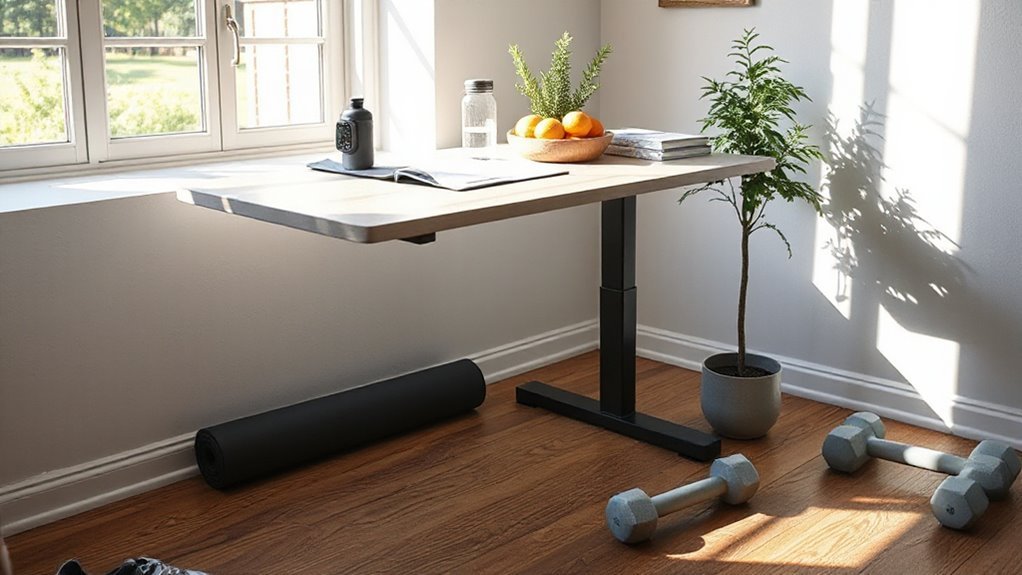
Combining standing desks with lifestyle changes can enhance health outcomes beyond the modest calorie burn associated with standing alone. Research shows that using sit-stand desks decreases sedentary time by about 90 minutes daily, promoting health benefits like improved insulin resistance and vascular function.
However, standing alone is insufficient for significant weight loss. To maximize benefits, you should incorporate low-intensity physical activities, like walking, throughout your day. Standing burns approximately 54 extra calories over six hours, but for meaningful weight reduction, you need higher intensity activities.
Frequently Asked Questions
Can Standing Desks Improve Posture and Reduce Back Pain?
Yes, standing desks can improve posture and reduce back pain. They promote better spinal alignment, decreasing forward head posture and encouraging a neutral spine.
Research indicates significant improvements in neck and back alignment with standing desk use. Additionally, standing desks relieve pressure on the spine, lowering discomfort associated with prolonged sitting.
Alternating between sitting and standing every 30–60 minutes further enhances posture and reduces the risk of developing musculoskeletal disorders.
How Do Standing Desks Affect Focus and Productivity at Work?
Impact on Focus and Productivity
Standing desks enhance focus and productivity greatly. Users report improved concentration and mental clarity, especially during afternoon energy lows.
Research indicates that standing promotes alertness, leading to up to a 46% productivity increase. Users experience decreased discomfort in areas like the back and neck, minimizing distractions.
Over time, productivity gains stabilize, with many noting increased energy levels and higher engagement in tasks, fostering a more effective work environment.
Are Standing Desks Suitable for Everyone, Including Those With Health Conditions?
Standing desks aren’t suitable for everyone.
Individuals with severe joint or circulatory issues should consult a healthcare provider before use. Those with specific musculoskeletal conditions may experience discomfort when standing for long periods.
However, many users report reduced neck and shoulder pain after several weeks.
Do Standing Desks Require Any Special Ergonomic Adjustments?
Yes, standing desks require specific ergonomic adjustments. Set the desk surface at elbow height, guaranteeing your arms bend at 90 degrees.
Position the monitor at eye level, approximately 20–30 inches away, to avoid neck strain. Keep your wrists straight and align your forearms parallel to the floor.
Utilize anti-fatigue mats for comfort and consider footrests for weight shifting. Regular adjustments secure ideal posture and reduce fatigue during prolonged standing.
How Can I Transition From Sitting to Using a Standing Desk Effectively?
Start by standing for 15-30 minutes each hour, gradually increasing your time to build tolerance.
Alternate between sitting and standing to minimize discomfort. Adjust your desk height for a 90-degree elbow angle, and keep your monitor at eye level.
Use supportive footwear and consider an anti-fatigue mat. Set reminders for standing intervals and incorporate micro-movements to enhance circulation.
Monitor any discomfort and adjust your standing duration as needed.
Conclusion
Standing desks can contribute to weight loss, but they aren’t a standalone solution.
Studies show that standing burns about 50 more calories per day than sitting. However, this increase is modest.
To maximize weight loss, combine standing desks with regular physical activity and a balanced diet.
While standing may reduce sedentary time, effective weight management requires a holistic approach and lifestyle changes for sustainable results.