Electric Vs Manual Standing Desk Converters
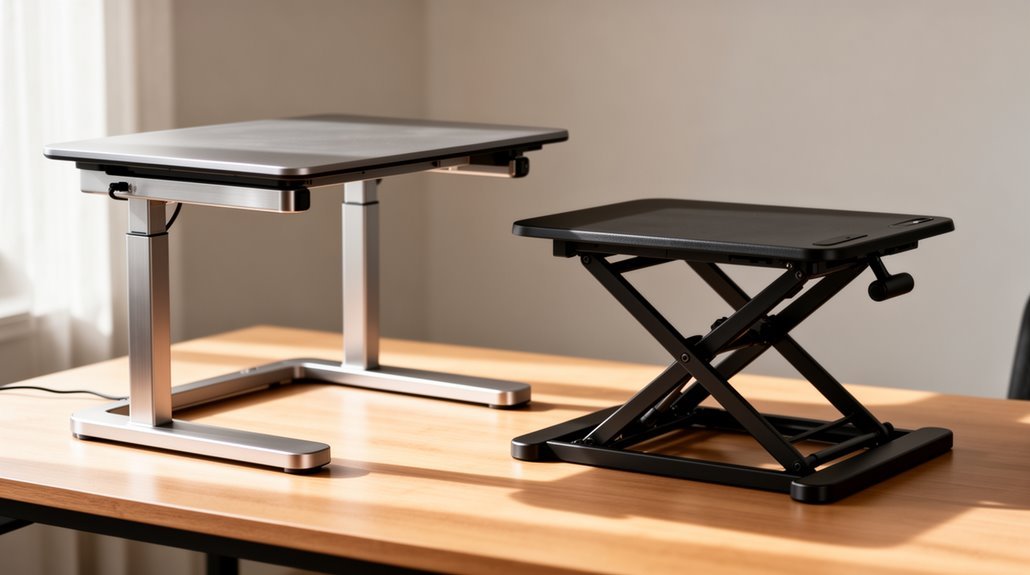
Electric vs manual standing desk converters each have clear advantages depending on how you plan to use them.
Electric standing desk converters offer motorized height adjustments for convenience and fast changes, typically moving between 0.86 and 3.1 inches per second. They generally cost $200 to $600 and are well suited for frequent transitions throughout the day.
Manual converters usually range from $100 to $300 and use hand cranks, which require physical effort but reduce the number of mechanical parts. That simpler design can enhance durability and lower maintenance needs.
Both options present distinct trade-offs in function, speed, and price, so choose based on your priorities for convenience, budget, and long-term reliability. You’ll find more insights on these choices shortly.
Overview of Standing Desk Converters
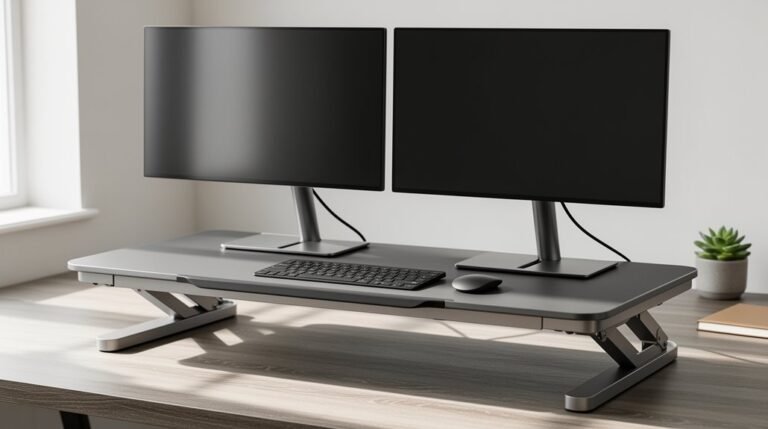
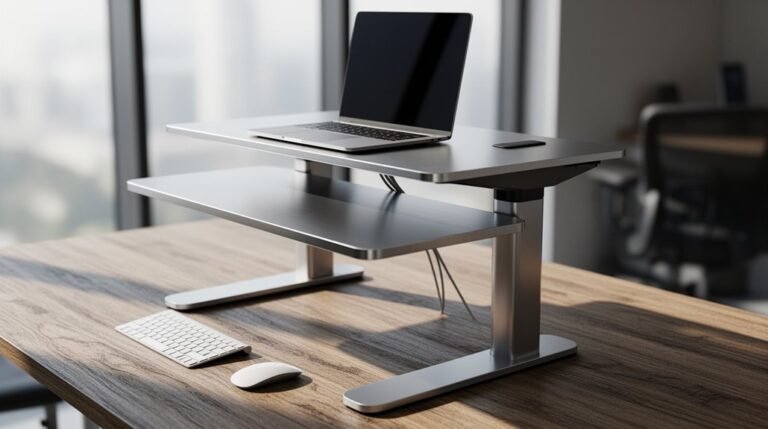
As you explore the world of standing desk converters, you’ll find they serve as practical solutions for creating flexible workspaces. Various types exist, including X-lift, Z-lift, L-lift, hovering, and electric converters. X-lift converters use an X-pattern frame, while Z-lift converters feature a Z-shaped design for larger upper workspaces. L-lift models provide extra surface area with their L-shaped platform, and hovering converters float above desks for maximum flexibility. Electric converters offer effortless height adjustments via a motor, making them a height-adjustable mechanism for traditional desks. Most models fit on existing desks, allowing for easy installation. X-lift and Z-lift models are typically manual, while electric options provide push-button operation for smooth shifts. Each type accommodates different workspace requirements, ensuring a solution for every user.
Mechanisms of Adjustment: Electric vs. Manual
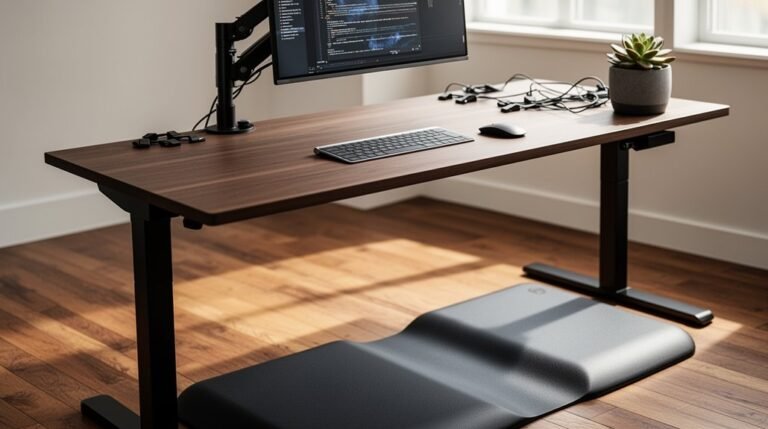
Electric converters use brushed DC motors and gears for precise height adjustments. These motors convert electrical power into mechanical force, enabling smooth, linear movement. Hall effect sensors help track leg position, while remote controllers allow easy height changes. Additionally, electric converters often feature key safety features like safety lock functions to prevent accidental adjustments.
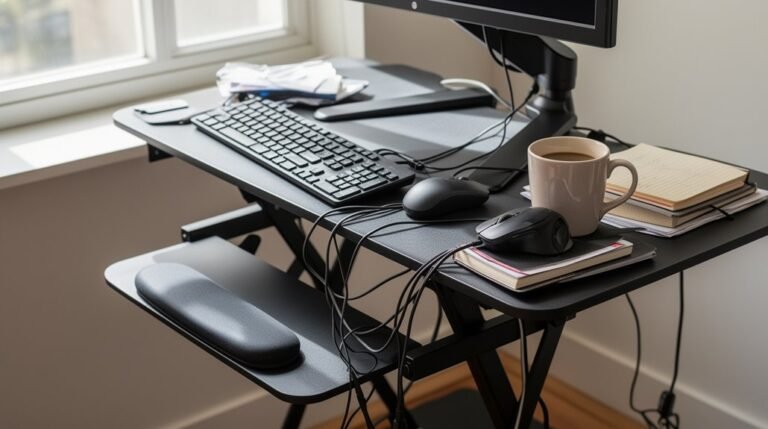
In contrast, manual converters rely on hand cranks, requiring physical effort for height adjustments. This system is slower, as it depends entirely on user strength. Gas spring and pneumatic systems offer a middle ground, providing assistance with less effort.
Electric models are typically more dependable due to their motor-driven operation, while manual systems are cheaper and require less maintenance, functioning even during power outages.
Speed and Efficiency in Height Adjustment
Standing desk converters vary greatly in their speed and efficiency for height adjustments.
Electric converters typically adjust height at speeds between 0.86 inches per second and 3.1 inches per second. Shifting from sitting to standing usually takes 10 to 15 seconds, while high-speed models can complete this in just 5 to 7 seconds. Additionally, electric converters often feature height adjustment mechanisms that allow for more precise customization for the user.
In contrast, manual converters require 5 to 10 seconds, but their speed depends on your strength and technique. This inconsistency can hinder frequent adjustments.
Electric models promote effortless, rapid switching, encouraging better ergonomic habits. They also maintain a consistent and smooth operation across repeated uses.
Therefore, electric converters greatly enhance efficiency and support seamless workflow, while manual converters may disrupt your productivity.
Cost Considerations and Budget Implications
When evaluating standing desk converters, cost considerations play an essential role in your decision-making process.
Electric standing desk converters typically range from $200 to $600+, while manual models generally range from $100 to $300. Entry-level manual converters can be found for under $150, making them budget-friendly.
Electric converters consistently cost more due to their additional features, like USB charging, and the need for a power source. Manual models, such as the Vivo DESK-V000B, offer significant savings while delivering core functionality.
If you’re on a tight budget, manual converters provide 80% of premium features at a fraction of the cost.
Consider your usage frequency and budget when choosing the right converter for your workspace.
Durability and Reliability Comparison
While both manual and electric standing desk converters offer distinct advantages, their durability and reliability differ greatly.
Manual desks have fewer mechanical components, which means fewer points of potential failure. Their hand crank systems operate without electrical motors, eliminating risks of motor burnout. With proper care, these desks can function reliably for over ten years.
In contrast, electric desks rely on motors, making them more vulnerable to failure. Electrical wiring and control systems can malfunction, often leading to issues before other components. High-quality electric desks may last a similar lifespan, but brand quality greatly impacts reliability.
Regular maintenance is essential for both types, as proper usage and adherence to weight limits extend their operational life.
Weight Capacity and Lifting Power
Understanding weight capacity and lifting power is essential when selecting a standing desk converter.
Electric converters typically support 30 to 44 pounds for the main desktop, with some high-end models reaching up to 80 pounds. In contrast, manual converters usually accommodate 20 to 35 pounds.
The lifting mechanisms also differ; electric models use motors for smooth lifting, while manual units rely on spring-assisted mechanisms.
Keyboard trays on both types have lower weight limits, typically 5 to 11 pounds for electric and even less for manual.
Overloading a converter can lead to instability and operational issues. Therefore, evaluating your equipment’s weight, including monitors and laptops, guarantees you choose a converter that meets your needs without compromising performance.
Advanced Features and Customization Options
Choosing a standing desk converter involves more than just weight capacity; it also includes advanced features that enhance functionality and user experience. standing desk converter benefits for productivity are well-documented, offering a range of advantages that can lead to better focus and efficiency during work hours. Many users report improved energy levels and reduced fatigue, which can contribute to a more engaged work performance. Additionally, these converters allow for easy transitions between sitting and standing, promoting healthier posture and reducing the risk of sedentary-related issues. In addition to these benefits of standing desk converters, users often experience a boost in creativity and collaboration, as their ability to adjust their workspace encourages movement and interaction. Moreover, incorporating standing desk converters into an office setup can lead to a more dynamic environment, making it easier for teams to engage and brainstorm effectively. This adaptability not only enhances personal well-being but also contributes to a more productive workplace culture.
Electric converters, for instance, utilize motorized systems with push-button controls for effortless height adjustments. In contrast, manual converters employ spring-loaded or gas spring mechanisms for smooth lifting without electricity. Z-lift models feature crank or lever systems for quick adjustments.
Stability is essential; dual-spring systems minimize wobble, while weighted bases enhance platform stability. Additionally, L-lift converters provide spacious surfaces, accommodating multiple monitors.
Pre-assembled electric models save time, and built-in cable management keeps your workspace tidy. With adjustable height ranges and durable finishes, these converters cater to diverse workstation needs, ensuring a functional and organized environment.
Frequently Asked Questions
Can I Use a Standing Desk Converter on Any Existing Desk?
Yes, you can use a standing desk converter on most existing desks, provided they meet specific dimensions.
Measure your desk’s width and depth to guarantee compatibility with the converter’s base. Check the converter’s weight capacity, as it must support your equipment. A sturdy, flat surface is essential for stability.
Some converters require minimal assembly or clamping, so verify your desk edge accommodates those features. Overall, choose a model that fits your workspace efficiently.
How Do I Maintain My Standing Desk Converter?
To maintain your standing desk converter, regularly wipe surfaces with a soft, damp cloth.
Use mild soap for tough stains.
Lubricate gas springs and moving parts as per manufacturer instructions, guaranteeing smooth adjustments.
Inspect bolts and screws every three months for tightness.
Manage cables with clips to prevent tangling, and check weight limits to avoid mechanical failure.
Finally, verify all safety features function correctly before use.
Are There Any Health Benefits to Using a Standing Desk Converter?
Absolutely, using a standing desk converter offers several health benefits.
It promotes better posture, reducing neck and back strain. Alternating positions enhances circulation, lowering the risk of cardiovascular issues.
You’ll burn more calories standing, contributing to weight management. Regular use decreases discomfort and fatigue, improving overall energy levels.
By changing your position every 30 minutes, you minimize muscle strain and support spinal alignment.
What Are the Best Brands for Standing Desk Converters?
For standing desk converters, consider VariDesk, Ergotron, Flexispot, Mount-It!, and Duke VESA.
VariDesk features robust construction and stability, supporting up to 35 pounds.
Ergotron offers smooth adjustments with a focus on ergonomics.
Flexispot provides both manual and electric options, accommodating weights up to 44 pounds.
Mount-It! excels in stability for dual-monitor setups.
Duke VESA is ideal for heavy-duty use, ensuring high weight capacity and durability across demanding environments.
Can I Adjust the Height of My Desk Converter While Working?
Yes, you can adjust the height of your desk converter while working.
Most converters allow for smooth shifts between sitting and standing positions. Electric models use push-button adjustments, letting you change height levels quickly, often up to 21 inches.
Manual options require some physical effort, utilizing levers or handles. Regardless of the type, make certain your workspace is clear to prevent damage during adjustments, and always lock the height securely after making changes.
Conclusion
In choosing between electric and manual standing desk converters, consider your specific needs and workspace.
Electric models offer convenience, adjusting at the push of a button, akin to having a smart assistant.
Manual converters, while requiring more effort, can be more cost-effective and equally durable.
Ultimately, the right choice depends on your budget, desired features, and how frequently you plan to adjust your desk. Evaluate these factors to find the perfect fit for your work environment.