Under-Desk Bike Vs Treadmill: Which to Choose?
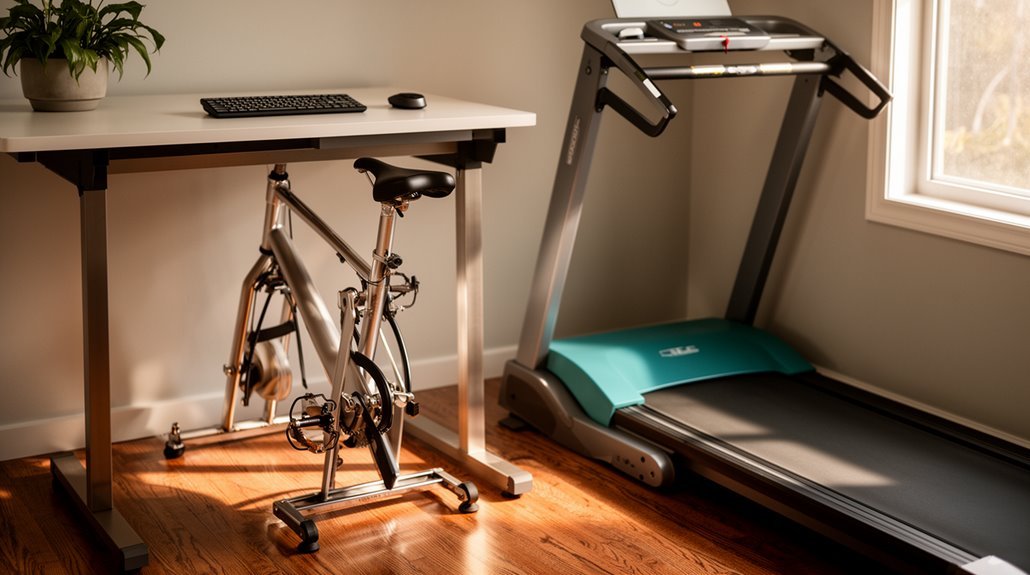
When choosing between an under-desk bike and a treadmill, consider space, cost, and noise levels. An under-desk bike is compact (footprints around 25″ x 36.5″), less costly (typically $200–$2,000), and operates quietly so you can focus on work. They can help burn roughly 400–600 calories daily.
Treadmills require more space, generally start at about $500, and may produce enough noise to disrupt concentration. Evaluate your fitness goals and workspace to guide your decision, and you’ll find additional insights ahead.
Space Requirements for Home Offices
When you’re setting up a home office, understanding the space requirements for fitness equipment is vital.
Under-desk bikes typically have compact footprints, with sizes like 25″ W x 36.5″ D for the FitDesk. Mini pedal exercisers are even smaller, such as the Zimtown at 16.93″ x 14.96″ x 12.20″. Treadmills, however, usually require more space, often exceeding 40″ in depth and 20″ in width. They need significant clearance, both front and back, to guarantee safe mounting and dismounting.
Desk height compatibility is essential; adjustable desks work best with under-desk bikes. Additionally, foldable options like the WalkingPad W1B offer space-efficient storage flexibility, while heavier treadmills may demand dedicated space, complicating their relocation in your office.
Cost and Maintenance Considerations
Considering the financial implications of fitness equipment in your home office, understanding the costs and maintenance needs is essential.
- Cost: Under-desk bikes typically range from $200 to $2,000, while treadmills start around $500.
- Maintenance: Bikes have fewer mechanical parts, leading to lower maintenance needs compared to treadmills, which require frequent upkeep due to their motors and belts.
- Durability: Under-desk bikes often last longer than inexpensive treadmills because of their simpler designs. Additionally, bikes are generally easier to move and assemble, making them a more convenient option for home office spaces.
Calorie Burn: Which Option Is More Effective?
Treadmill desks generally burn 600–800 calories per day with moderate use, while under-desk bikes burn 400–600 calories daily with consistent pedaling. The calorie burn depends on your weight, effort level, and workout duration. Treadmill desks engage more muscle groups through weight-bearing activity, leading to higher calorie expenditure. For instance, walking at 2.5–3 mph burns 240–300 calories per hour for a 150-pound person. In contrast, moderate pedaling on under-desk bikes burns about 300–600 calories per hour. Consequently, if your goal is maximum calorie burn, treadmill desks are more effective. However, if you prefer low-impact exercise, under-desk bikes still provide significant benefits for cardiovascular health. Additionally, using an under-desk bike offers low-impact motion, making it gentler on your joints compared to higher-intensity treadmill workouts.
Noise Levels and Work Environment
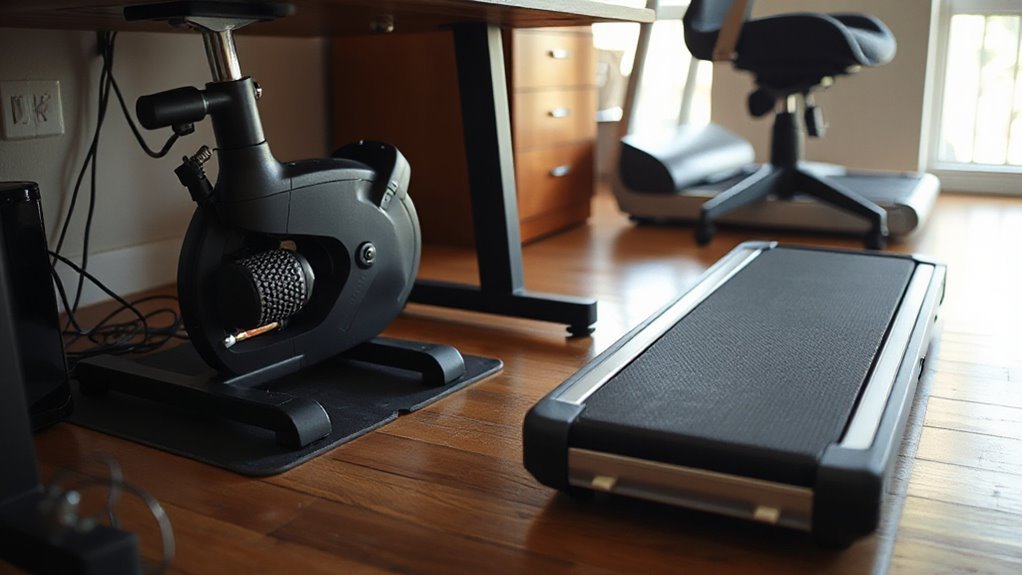
What role do noise levels play in your work environment when choosing between an under-desk bike and a treadmill? Noise can greatly affect your concentration and productivity.
- Under-desk treadmills typically generate noise levels between 42 dB and 65 dB, increasing with speed, which can disrupt work.
- Treadmills may be suitable for mild use, but noise tends to rise above 2 mph, impacting phone calls and meetings.
In contrast, under-desk bikes are generally quieter, with models like the Vivo DeskCycle operating at whisper levels, allowing for minimal disruption.
Choosing equipment with lower noise profiles is essential, especially in shared office spaces, to maintain a focused and efficient work environment without unnecessary distractions.
Compatibility With Different Types of Work
When you’re evaluating fitness equipment for your workspace, compatibility with desk-based tasks is essential.
Under-desk treadmills suit low-focus activities like emails, but they can hinder typing accuracy and speed. If your work involves intense typing or fine motor skills, a desk bike is preferable.
Pedaling allows for seated work without disrupting hand-eye coordination. Treadmills require more desk clearance, limiting access to drawers or shelves.
In contrast, desk bikes fit under most standard desks, making them ideal for smaller spaces. They adapt well to various layouts and are easier to move.
Health Benefits and Comfort Levels
While both under-desk bikes and treadmills offer distinct health benefits, their comfort levels and usability differ considerably.
Under-desk bikes promote cardiovascular health by increasing heart rate and improving circulation, while treadmills strengthen core muscles and improve posture.
Consider these comfort aspects:
- Space Efficiency: Under-desk bikes fit well in smaller office environments, whereas treadmills require more space.
- Noise Levels: Bikes operate quietly, allowing you to focus, while treadmills can be noisier, especially at higher speeds.
- Ergonomic Comfort: Lower work rates on bikes yield greater comfort, while treadmills allow full-body movement, reducing stiffness.
Both options enhance productivity and support various fitness levels, but your choice should align with your workspace and personal preferences.
Intensity of Workouts: Bikes vs. Treadmills
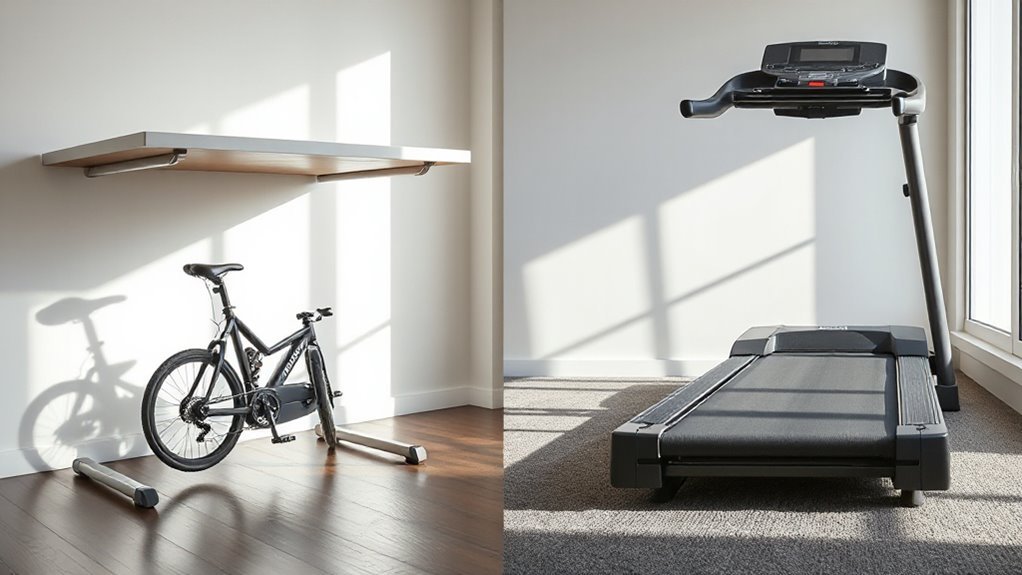
Intensity of workouts varies considerably between under-desk bikes and treadmills, impacting overall fitness results and workout experiences.
Treadmills typically burn more calories; running can result in 530 calories per hour, compared to 350 calories cycling. Running engages multiple muscle groups, including legs, core, and arms, providing a thorough workout.
In contrast, stationary bikes primarily focus on lower body muscles, such as quads and hamstrings. While vigorous pedaling can increase intensity, it usually falls short of treadmill running.
Additionally, treadmills offer adjustable speed and incline, allowing for tailored workouts. For low-impact exercise, under-desk bikes reduce joint stress but may lack the same intensity as treadmill workouts, making them suitable for different fitness objectives.
Suitability for Different Fitness Levels
Understanding the suitability of under-desk bikes and treadmills for various fitness levels is essential for making informed exercise choices.
Beginners and Sedentary Individuals
- Under-desk bikes provide low-impact exercise, ideal for those shifting from a sedentary lifestyle.
- The seated position offers comfort, allowing you to focus on work while cycling.
- Adjustable resistance enables you to customize the workout as your fitness improves.
Individuals Recovering from Injury
- Exercise bikes offer no-impact cardiovascular workouts, minimizing stress on joints during recovery.
- The smooth pedaling motion reduces the risk of re-injury.
- Seated designs help alleviate strain on the lower back.
Advanced Athletes
- Treadmills provide adjustable speed and incline, enhancing HIIT training.
- Weight-bearing exercises improve bone density effectively.
Storage and Portability Factors
When evaluating your options, it’s important to take into account how storage and portability impact your daily use of under-desk bikes and treadmills.
Under-desk bikes typically occupy less floor space, making them ideal for small apartments or crowded offices. Their slim design allows for vertical storage under desks or in closets.
In contrast, treadmills have a bulkier footprint and require more space, even when using foldable models. Additionally, bikes are lighter and easier to move, which simplifies relocating them between rooms.
Treadmills often feature wheels but remain heavier due to motorized components. Overall, under-desk bikes offer superior portability and storage convenience, making them suitable for users with limited space or those who frequently change workout locations.
Personal Preferences and Lifestyle Considerations
In choosing between an under-desk bike and a treadmill, your personal preferences and lifestyle greatly influence the decision.
Consider the following factors:
- Workout Intensity: Treadmills provide higher calorie burn during intense workouts, while bikes offer low-impact, joint-friendly exercise.
- Work Compatibility: Bikes allow for easier multitasking across various tasks; treadmills are better suited for light tasks only.
- Comfort Levels: Bikes minimize joint stress, making them ideal for those with pre-existing conditions, unlike treadmills which can be harder on joints.
Assess your fitness goals, workspace environment, and comfort needs.
Balancing these factors will help you make an informed choice tailored to your daily routine and health requirements.
Frequently Asked Questions
Can I Use an Under-Desk Bike While Standing?
No, you can’t use an under-desk bike while standing.
These bikes are designed for seated use, and standard models don’t support pedaling in an upright position. The bike remains on the floor, making seated pedaling the only option.
Adjust your desk height to accommodate the bike comfortably while sitting.
For standing exercise, consider alternatives like treadmill desks or portable stand-up ellipticals that allow for movement while standing.
How Do I Choose the Right Resistance Level for Biking?
Start with the lowest resistance to warm up and assess comfort.
Gradually increase resistance to challenge your muscles while monitoring fatigue.
If your goal is light activity, maintain lower resistance for sustained pedaling.
For strength training, higher resistance is beneficial but may restrict multitasking.
Use perceived exertion or heart rate zones to guide adjustments.
Regularly reassess based on your endurance and workout objectives to optimize performance.
Are There Specific Brands Recommended for Under-Desk Bikes?
You should consider several top-rated brands for under-desk bikes.
Vivo DeskCycle offers eight resistance levels and the lowest pedal height.
DeskCycle 2 features adjustable heights and magnetic resistance.
Cubii models are popular for their large footplates.
If you’re budget-conscious, Himaly provides good value with adjustable resistance and a digital monitor.
Ultimately, Ergonomyx delivers a full-size experience with quiet operation and adjustable magnetic resistance.
Can I Watch TV While Using a Treadmill?
Yes, you can watch TV while using a treadmill, but it comes with some caveats.
Watching screens may alter your running form, causing higher impact and increased injury risk. It also distracts you from maintaining proper posture, which can lead to neck strain.
Additionally, holding onto the handles reduces calorie burn and exercise effectiveness.
While it might make your workout enjoyable, focus on your form to maximize benefits and minimize risks.
What Is the Average Lifespan of an Under-Desk Bike?
The average lifespan of an under-desk bike ranges from 3 to 10 hours of daily use, depending on the model.
For example, the LifeSpan C3-DT3 is designed for typical office use, while the TR5000-DT3 supports up to ten hours for high-volume deployments.
Durability varies, with premium models featuring aluminum construction and reinforced components, enhancing longevity.
Regular maintenance and appropriate usage can greatly extend the bike’s operational life within these parameters.
Conclusion
To summarize, choosing between an under-desk bike and a treadmill depends on your specific needs and work environment.
Curiously, studies show that incorporating just 30 minutes of physical activity into your daily routine can increase productivity by up to 20%. This statistic highlights the importance of integrating movement into your workday.
Consider factors like space, noise, and fitness levels to find the best fit for your home office.
Ultimately, both options can enhance your well-being and efficiency.